UConn KIDS Researchers Matthew Hall, Inge-Marie Eigsti, and Diane Lilo-Martin published

April 26, 2017

The researchers from UConn KIDS are always working hard and making awesome discoveries! The lead author on a new study, Matthew Hall, share a bit about what his newly published article is all about:

“For a long time, researchers and parents alike have observed that as a whole, deaf children seem to lag behind hearing children of the same age when in comes to “executive function”: a set of cognitive skills that help us flexibly deploy our cognitive resources to regulate our behavior and achieve desired goals. These skills are important predictors of school readiness & academic outcomes, so it’s important to figure out what’s causing these problems so that we can address them more effectively.  If the underlying cause turns out to be deafness itself, as has been proposed by previous studies, then providing early access to sound via hearing technology would be important. But if the underlying cause turns out to be a lack of exposure to language, then provided early access to *language* would be important, and it could be that sign language exposure is a more effective tool than spoken language.  This study addresses the issue of whether the deficits are better explained by access to sound or access to language.  We do so by looking at executive function in children who are deaf (no access to sound) but who are born into Deaf families where ASL is used from birth (full access to language).  This is where the two theories make contrasting predictions.  The results argue against the theory that sound is the critical factor, but are consistent with the theory that language is the crucial factor.  I do need to point out, though, that we can’t say that we’ve *proven* language to be the key.  It also remains to be seen whether deaf children from hearing families will show demonstrable benefit from early exposure to ASL: that’s what we’re hoping to address next.”

You can find the article in the Journal of Deaf Studies and Deaf Education. It was published in print in January of 2017.


UConn KIDS Researcher, Dr. Letitia Naigles, publishes a new article

April 17, 2017


Dr. Letitia Naigles, a UConn KIDS researcher, is interested in how young children aquire language. Dr. Naigles looks at language development in both typically developing children and children with autism. “My research focuses on the interacting roles of linguistic input and linguistic, cognitive, social, and neurological predispositions in children’s acquisition of word meaning, sentence structure, and discourse patterns” writes Dr. Naigles. One of her most recent publications in the journal Autism Research looks at how brain structure is associated with language ability in preschool-aged boys with Autism Spectrum Disorder. Dr Naigles’ findings  suggest that the strength of the connection between the occipital lobe, which processes what you see, and the temporal lobe, which processes what you hear, is greater in children with larger vocabularies.

The article was published online by Autism Research on March 16, 2017.

Sesame Street’s Newest Muppet and a look at Autism Awareness Month

April 6, 2017

A few weeks ago, Sesame Street announced the newest Muppet to join the show – Julia, who has Autism. In the United States, autism occurs in 1 out of every 68 births. With such a high prevalence, the addition of this new Muppet is refreshing.”We wanted to express some of the characteristics of autism in a positive way” and to break down “myths and misconceptions around autism,” said Jeanette Betancourt, Sesame Workshop’s vice president of outreach and educational practices.

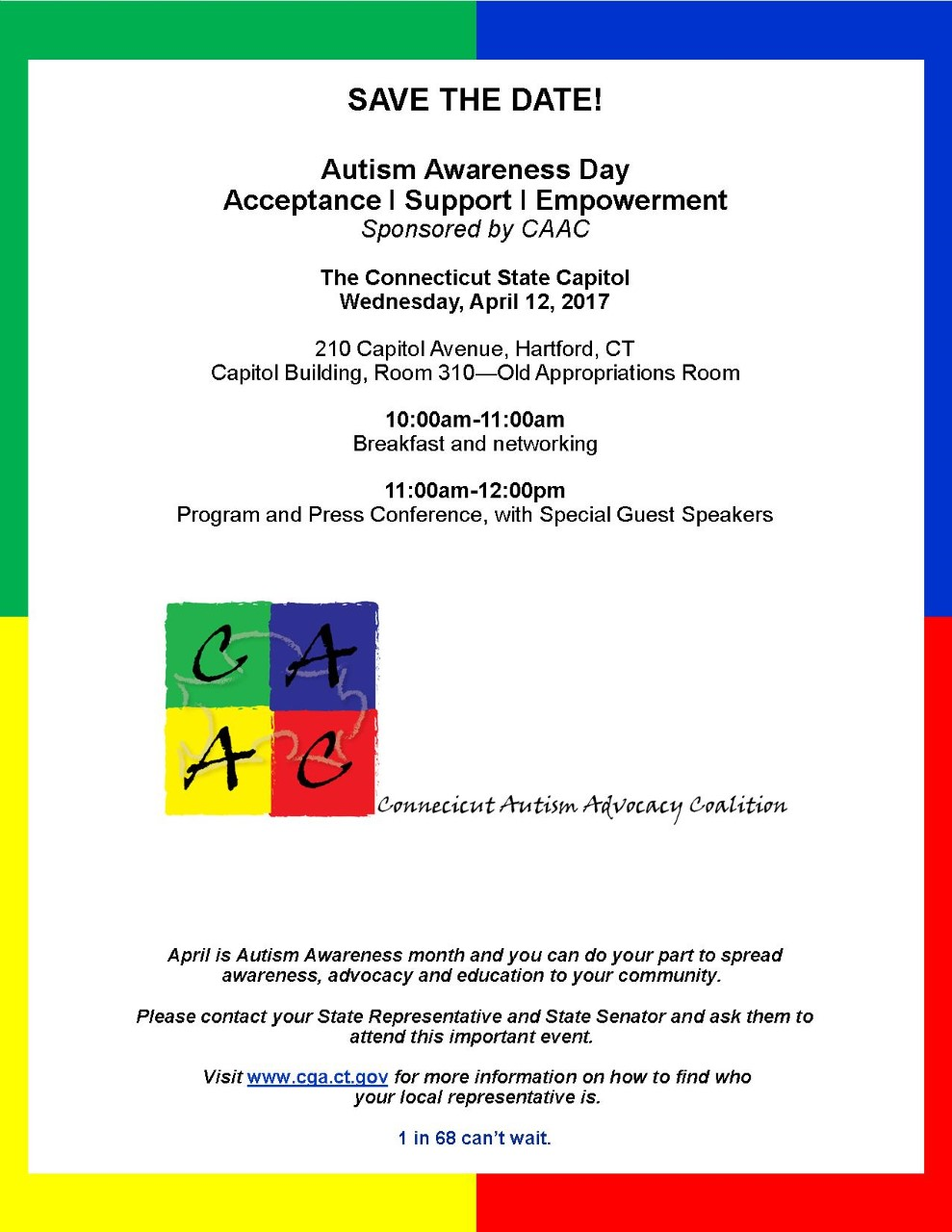
We would also like to draw attention to an upcoming event: next week at the Connecticut State Capital is Autism Awareness Day. As UConn KIDS continues to do research on autism, will be attending. We hope to see you there!

All of April is Autism Awareness month, so visit https://www.autism-society.org/ for more ideas on how to get involved in raising awareness for autism.

New Report from Connecticut Voices for Children looks at Youth Outcomes and Community Opportunity

March 20, 2017

A new report from Connecticut Voices for Children looks at the relationship between youth outcomes and community opportunity:

“The report finds significant disparities in communities across Connecticut based on demographic factors, including population density, residential segregation, and average income. Youth growing up in dense, low-income areas and areas with segregated populations of racial minorities are more likely to struggle, while youth growing up in wealthier rural and suburban areas with predominantly white residents have more positive outcomes. These community characteristics correlate with factors that may negatively impact youth throughout their lives: teen birth rates, youth disconnection, and juvenile arrests.” However, “…by examining outliers among otherwise similar communities, this report identifies successful policies and practices to improve these youth outcomes.”

You can find the full report here:
http://www.ctvoices.org/YouthAtlas

Also read a WNPR Article providing a quick look at the report here:

http://wnpr.org/post/study-suggests-teenagers-do-better-if-their-city-officials-collaborate


Children with Disabilities at Higher Risk of Maltreatment or Neglect

March 8, 2017

A recent study set for publication in the April edition of Pediatrics analyzed data from 524,534 children born in Western Australia between 1990-2010 and found that children with intellectual disability, mental and behavioral health problems, and conduct disorder were more likely to be maltreated or neglected than their typically developing counterparts. While these findings come from Australia, they are consistent with similar studies completed internationally. This article highlights concerns about the rights and needs of children with developmental disabilities, and the need to advocate for their well being.

UConn KIDS seeks to do just that through our ongoing research into atypically developing children. To further our goal, we will also be attending the LEARN Disability Summit at Mohegan Sun on March 11, and will be sharing a table with UConn’s Center for Excellence in Developmental Disabilities.

If you’re interested in getting more involved in advocating for the rights and needs of children with developmental disabilities, be sure to attend the upcoming CT Council for Disabilities public forum on March 14 and Autism Awareness Day at the State Capitol on April 12!

Visit HealthyChildren.Org to read about the research.

Study finds students who experience chronic bullying suffer academically.

February 7, 2017

A study completed by researchers at Arizona State University tracked students over more than a decade to analyze how bullying impacted academic achievement and school engagement. They found that students who were chronically bullied were more likely to suffer academically, highlighting the need for more anti-bullying school programs, as well as parental awareness of bullying.

“Children who suffered chronic levels of bullying during their school years (24 percent of sample) had lower academic achievement, a greater dislike of school and less confidence in their academic abilities. Children who had experienced moderate bullying that increased later in their school years (18 percent) had findings similar to kids who were chronically bullied. However, children who suffered decreasing bullying (26 percent) showed fewer academic effects that were similar to youngsters who had experienced little or no bullying (32 percent), which revealed that some children could recover from bullying if it decreased. Boys were significantly more likely to suffer chronic or increasing bullying than girls.” (American Psychological Association)

Find more information about the study via CNN and the American Psychological Association.

UConn’s Rudd Center finds increase in food marketing to youth; black youth exposed to more junk food ads than white youth

January 25, 2017

The UConn Rudd Center for Food Policy and Obesity released a study on December 16, 2016 that analyzed the patterns of youth TV viewership and food advertising to preschoolers, children, and adolescents. Despite no difference in youth’s time spent viewing TV between 2008 and 2012, there was a marked increase in the number of food and beverage advertisements youth were exposed to. Another key finding: Black youth were exposed to more junk food ads than white youth.

The study was published in Pediatric Obesity. You can read about the study in UConn Today.

How powerful is advertising on kids’ food choices?

December 2, 2016

The UConn Rudd Center for Food Policy and Obesity explains the powerful effects of food advertising on Preschoolers, as outlined in a new study.

“If the ads were for healthy foods, that would be an asset to parents, but when the ads are for unhealthy foods, they make parents’ job harder,” a representative from Rudd said.

Read more here about a study that illustrates the effect of advertising on children’s food choices.