

Author: Grace

Why Do We Use Baby Talk?

Talking in baby talk might feel silly, but babies are paying close attention. Language learning starts much earlier than you would expect, and baby talk is part of how babies learn. 

This article explains that even though babies actually understand a lot more language than people think. Linguistics professor Jeffrey Lidz has spent years studying how young children learn language. His research shows that babies start to understand important parts of language like sentence structure, much earlier than expected. 

In a recent study, Lidz and his colleague found that by around 18 months, children already have a strong understanding of syntax (how words are arranged in sentences). Toddlers still understand things like the difference between nouns and verbs and how words in a sentence connect to each other, even if they struggle to speak clearly.  

Using baby talk with simplified speech and exaggerated tone helps babies pay better attention to sounds and patterns, making it easier for them to learn language. 

Click here to learn more!

Grace Hoey

UConn KIDS Research Assistant

Trivia Tuesday!

Welcome back to Trivia Tuesday with UConn KIDS!

Last Week’s Question: Around what week of pregnancy do babies begin to smell the same smells as their mother?

Last Week’s Answer: 20 weeks


This week’s question is…

What is the recommended amount of daily exercise for elementary age children?

A) 30 minutes

B) 60 minutes

C) 15 minutes

D) 90 minutes

Tune in next week for the answer!

When Should You Start Swim Lessons?

All children should have swimming lessons. According to the CDC, drowning is the leading cause of death in children ages 1-4. It is important to do everything you can to prevent accidents from happening, but what are the age-appropriate steps to take with swimming lessons?

Start early by helping your child get familiar with the bathtub. Use this controlled, safe environment to get your child used to the feeling of water on their face and their head briefly under water. Try filling up the bathtub more to help them feel what it means to float. Practicing blowing bubbles underwater also helps with breath control and reduces the risk of swallowing water. Confidence in swimming begins at home with active supervision in the bathtub.

Every child’s development is different in terms of their readiness for swimming lessons, but around the age of 4, children typically gain the cognitive skills necessary to follow instructions and retain new information. This is the perfect time to introduce your child to swimming lessons to keep them safe in the water. Knowing how to float, tread water, and swim to a surface are skills that can save their lives.

Getting some resistance from the child because they are scared of the water is normal, as swimming can be a strange, new experience. That being said, it is so important to keep persevering for the sake of your child’s safety. Gradually increasing familiarity with the use of active support and positive reinforcement can help make the process less scary.

As they master the basics of swimming safety and get older, they can move on to learn different strokes. Spending more time in water with family and friends increases their knowledge of the different ways to move underwater.

Prevention of accidents does not only include swimming lessons, but it also includes constant active supervision by an adult, use of proper floatation devices, and accessibility to a safe area to swim.

Click here to learn more!

Grace Hoey

UConn KIDS Research Assistant

What Your Child’s Tantrum Might Be Telling You

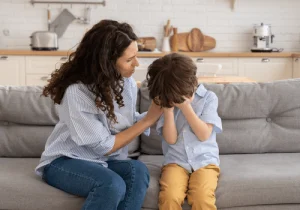
Almost every parent has experienced the moment when a child suddenly starts screaming, crying, or throwing themselves on the floor. These tantrums can feel overwhelming and confusing, leaving many parents wondering what they did wrong or how to make it stop. Tantrums are a pretty typical part of childhood, according to Jen Lumanlan’s article “Six Ways to Respond to Your Child’s Tantrum”. Tantrums are used by young children to communicate bigger emotions that they are unable to verbalize.

Lumanlan discusses several studies on why tantrums occur. Tantrums are more common when a child is exhausted, frustrated, hungry, or seeks attention from a parent. Children also frequently become irritated when they try to do something that is too difficult for them or when they want to do something on their own but can’t quite execute it. These overwhelming breakdown moments are usually about the childs actual emotions and needs.

The article also provides parents with helpful advice on how to respond. One important approach is to be calm yourself when entering the situation because children frequently ‘borrow’ or mirror the emotions of people around them. Grounding yourself and leading with compassion will benefit both the parent and the child in this circumstance. Another tip is to wait until the child has let it all out and calmed down before discussing what happened in order to assist them put their emotions into words by explaining what just happened. Lumanlan also really stresses the need of acknowledging the child’s emotions rather than punishing them or surrendering to every demand from the child.

Parents can help their children learn to handle big feelings and develop stronger emotional skills over time by recognizing what a tantrum is truly saying, and communicating this to the child.

Click here to read more!

Grace Hoey

UConn KIDS Research Assistant

How to Support Your Child’s Writing Development

The National Association for the Education of Young Children (NAEYC) published this helpful article introducing several strategies to promote writing development in children!

Your family works a team that encourages and supports your childs proper development so that they can thrive. By providing different fun activities that families can engage in with their kids, advanced writing skills become more accessible. These activites can be practiced to build fine motor skills, stamina, and confidence in themselves.

Incorperating writing activities into your family’s daily life can help children see it as a natural and enjoyable part of life. Making lists, labeling pictures, writing cards, and creating stories allow children to practice writing in ways that feel meaningful. Celebrating effort and creativity rather than perfection leads children to more likely feel proud of their work and motivated to continue developing their writing skills.

Click here to read the article and learn more!

Grace Hoey

UConn KIDS Research Assistant
Choosing How to Feed Your Baby

Why has feeding a baby become one of the most controversial parenting choices? Is there actually a significant difference between breastfeeding and formula feeding? Infant nutrition has been shaped throughout history by both science and societal opinion, as seen in todays video.

This video explores the history and science behind baby formula while challenging common myths and stereotypes. Using both humor and accurate scientific information in a skit format, a clear message is relayed to parents everywhere. They discuss various research studies and feature a lactation expert who explains that breastfeeding and formula feeding are both equally effective for helping a baby grow and develop.

Both breastfeeding and formula provide babies with the essential nutrients they need. Modern infant formula is carefully created by scientists to closely replicate the balanced nutritional components of breast milk. Formula is completely safe and an excellent nutritional source for infants. The video explains that a child’s long-term development depends on many things, not just how they are fed as a baby. What really matters is that the baby is nourished, safe, and surrounded by love.

It is important to remember that how a parent feeds their baby does not make them a ‘better’ or ‘worse’ parent. Some breastfeed, some use formula, and some do both! Feeding choices can depend so many factors; health, work, money, family structure, personal comfort, etc. All completely valid reasons. A mother who feels supported and happy in her choices helps her baby grow healthy and secure.

Check out this video for a fun and informative look at baby feeding methods!

Grace Hoey

UConn KIDS Research Assistant

The Role of Conflict in Healthy Sibling Relationships

Many parents worry when their children fight often. It can be stressful to hear that constant bickering, but conflict is actually a normal part of sibiling relationships and child development!

Sibilings spend a lot of their time together. Sharing toys, space, and attention can make disagreements bound to happen. Young children may not know how to express their feelings clearly, and older children tend to get annoyed easier. These differences in sibilings can lead to conflict, but this is expected.

Sibiling relationships are never entirely positive or negative. One moment they can be laughing and playing, and the next they are ‘enemies’. This does not mean that the realtionship is unhealthy, but it shows that they are learning how to navigate social interaction properly.

Conflict supports development and helps children learn important life skills. They can learn how to problem-solve, better understand other’s feeligs, control their emotions, and develop a sense of independence. These are all interpersonal skills they will need to create a healthy social life.

This article takes a look at the ‘essential ingredients’ and important factors in a sibiling relationship. Parents play a very important role in helping to build healthy relationships. They can stay calm during conflicts, help children talk through their problems, teach simpler problem-solving and emotional regulation skills, encourage shared activities, and treat children fairly and with respect. Instead of stopping every argument, parents can guide children towards better ways of learning to manage conflict. The goal is not to eliminate conflict, but help children learn to handle it in a healthy way.

Click here to read more!

Grace Hoey

UConn KIDS Research Assistant

Boredom can be a Good Thing for Kids?

With all the recent snow days, parents might be stuck at home hearing a lot of “I’m bored” from their kids all day. While most parents feel pressure to fix it right away, this article brings up great points that explain how boredom is actually not a bad thing.

1. Boredom helps kids slow down and notice the world around them. Instead of always being on screens or in planned activities, they start paying attention to small things and learning naturally. Kids are naturally curious, and working with their imagination, boredom gives them opportunities to explore.

2. Mental breaks are important. Being constantly busy can be overwhelming, and boredom gives their brains time to rest.

3. Creativity flourishes when kids are bored. They have to come up with their own ideas, like building something, pretending, or making games. These moments help them learn how to solve problems on their own. If everything is always planned for them, they do not get that chance.

4. Boredom also helps kids become more independent. Even something simple like figuring out what to do during a snow day teaches decision making and responsibility. These small moments actually matter more than they may seem.

Especially during snow days, it might be okay to let kids be bored sometimes instead of trying to fill every moment. That space helps them grow!

Click here to read more!

Grace Hoey

UConn KIDS Research Assistant

Today’s Friday Feature is Grace Hoey!

Grace Hoey is a Spring 2026 research assistant for UConn KIDS. She is a sophomore majoring in Human Development & Family Sciences and is in the Early Childhood Specializations program. She also works with the infants at the Child Development Labs. After graduation, she plans to attend occupational therapy school. Grace is so excited to have this opportunity!

Trivia Tuesday!

Trivia Tuesday

Welcome back to Trivia Tuesday with UConn KIDS!


Last weeks question was “Which cognitive milestone is most related to why peek-a-boo is such a fun game for babies?”

The answer is C. Object permanence


This weeks trivia question is:

What sense is most developed at birth?

a. Sight

b. Hearing

c. Taste

d. Smell

baby delivered and raising arm and fist during c section procedure in hospital operating room - baby being born stock pictures, royalty-free photos & images

Come back next week to view this week’s answer!