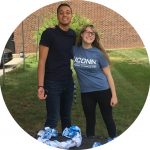
Today’s Friday Feature is Zyria Newman!

June 12, 2020

Today’s Friday Feature is Zyria Newman!

What is your name?
– Zyria Newman

Which lab are you representing?
– C.A.P. Lab

What is your position in the C.A.P. Lab?
– Research Assistant

Can you tell us more about what you do in your lab?
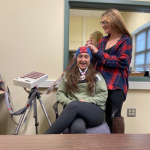
– I am an Undergraduate Research Assistant in UConn Waterbury’s C.A.P Lab. Currently we are looking at the building blocks of cognitive development in our Husky See, Husky Do study. Husky See, Husky Do is a longitudinal study that allows us to use EEG measurement to look at the “social brain” of infants and young children. The study focuses on imitation, learning, executive function skills, and socio-cognitive development.

How did you become interested in this area of research?
– I became interested in this area of research because I wanted to get out of my comfort zone, in terms of what I knew about psychology. This lab has introduced me to a lot of new resources, information, and skills that I would not have learned otherwise.

What are your plans and goals for the future?
– I will be graduating this December, and plan to continue my education in a School Psychology graduate program.

What do you like to do in your free time?
– Outside of school and lab I like to spend time relaxing at home with friends or family.

Image may contain: 1 person

Link to the C.A.P. Lab: https://kidcaplab.uconn.edu/
Today’s Friday Feature is Olivia Derella!

June 9, 2020

Today’s Friday Feature is Olivia Derella!

What is your name?
– My name is Olivia Derella.

Which lab are you representing and what is your position in the Lab?
– I’m a graduate student in the Behavioral and Affective Dysregulation: Course and Outcomes (BADCO) Lab, working with Dr. Jeffrey Burke.

Can you tell us more about the study you’re currently involved with?
– My dissertation project is called the “UConn Feelings in Families Study” (IRB # H18-180). We are trying to understand how children and parents cope with and talk about their emotions. In our study, we ask parents and kids to play computer games and answer questions that help us learn about frustration, anger, and irritability. Now we are learning how these families are coping with the COVID-19 pandemic, with support from the UCONN Institute for Collaboration on Health, Intervention, and Policy (InCHIP)!

At what stage are you in your current degree & what degree were you awarded previously?
– I’m a 6th year doctoral candidate in Child Clinical Psychology at UConn, and I got my Bachelor’s degree in psychology at SUNY Geneseo near Rochester, NY. I’m spending this year working at NewYork- Presbyterian/Columbia University Medical Center for my predoctoral internship.

What is your favorite topic to study?
– My favorite topic to study is how kids’ and parents’ emotions and behaviors impact each other. Since I am also a mental health clinician for kids and families, I conduct research to understand how to better help children and parents struggling with anger and irritability.

What do you like to do in your free time?
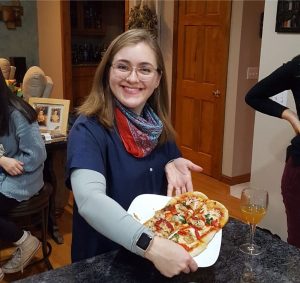
– I love to cook (and eat)! My favorite at-home activity this spring has been taking long walks at dusk and photographing all the flowers and trees in my neighborhood.

Link to the Behavioral and Affective Dysregulation: Course and Outcomes (BADCO) Lab website:
https://badco.uconn.edu

Today’s Friday Feature is Lucy Stone!

June 5, 2020

Today’s Friday Feature is Lucy Stone!

What is your name?
– Lucy Stone

Which lab are you representing?
– The NIDL lab working on the Family Brain Program with Dr. Hancock.

What is your position in the Lab?
– Research Assistant

What degree are you pursuing?
– Sophomore undergraduate pursuing a major in Allied Health Sciences

Can you tell us more about yourself?
– My name is Lucy Stone and I am from Fairfield, CT. I am a second-year undergraduate at the University of Connecticut majoring in Allied Health Sciences and minoring in Psychology. After getting my degree, I hope to get into a graduate program and eventually pursue a career in healthcare. I am interested in research because it allows me to explore and make contributions to topics I’m passionate about.

What is your favorite movie?
– My favorite movie is Elf because I love Will Ferrell and Christmas.

Link to the NIDL lab, Family Brain Program: http://nidl-lab.org/family/

Today’s Friday Feature is Francisco A. Carrillo!

May 29, 2020

Today’s Friday Feature is Francisco A. Carrillo!

What is your name?
– Francisco A. Carrillo

Which lab are you representing?
– UConn KIDS (Kids in Developmental Science)

What is your position in the Lab?
– Undergraduate Research Assistant

What degree are you pursuing?
– Sophomore undergraduate student // Psychological Sciences BA and Human Development and Family Studies Minor

What interests you about research?
– I think that research is an interesting way to find answers to complex questions. I always find myself analyzing how to handle specific problems or situations. Additionally, I enjoy research as it is always interesting and I’m always doing something new that takes me out of my comfort zone.

What are your future goals?
– Looking at my career path in the future, I might find myself doing some type of research within psychology or addressing clinical cases, maybe a combination of both (only time will tell).

Can you tell us a little more about yourself?
– I’m from San Juan, Puerto Rico. As for hobbies I enjoy playing sports (basketball and the gym overall), taking pictures and photography, listening to music (any genre to be honest) and watching movies (action movies are my favorites).

What is your favorite activity to do at home?
– Taking the COVID-19 pandemic into consideration, I would say that I have tried to diversified my at home activities. I enjoy watching series on Netflix, Hulu, and Disney +. My top three movies from Disney+ are: Cars 1, Coco, and Aladdin (2019). I also enjoy an occasional book as it adds to my knowledge and diversity.

Link to UConn KIDS website: kids.uconn.edu

Today’s Friday Feature is Candace Tang!

May 22, 2020

Today’s Friday Feature is Candace Tang!

What is your name?
– Candace Tang

Which lab are you representing?
– The NIDL lab working on the Family Brain Program with Dr. Hancock.

What is your position in the Lab?
– Research Assistant

What degree are you pursuing?
– Third year undergraduate student // Sociology
and Human Development and Family Studies – double major

What have you learned from working in the lab?
– In the lab I was excited to get to work with
students and faculty in a research lab that I wouldn’t normally have access to. It’s been a great chance for me to grow as a student. I’ve also been learning about how much work is put into organizing and creating these experiments for adults and kids. People in the lab have also taught us how MRI and EEG testing works which is very fun and interesting.

What are your future goals?
– I’m interested in working with children and adolescents and how public policies affect them in educational settings. Specifically I want to study educational development and possibly mental health later on when I pursue a masters degree.

What is your favorite activity to do at home?
– As of late I’ve been playing piano, drawing, and in addition, learning how to cook.

Link to the Family Brain Program: http://nidl-lab.org/family/

Today’s Friday Feature is Emily Hotz!

May 15, 2020

Today’s Friday Feature is Emily Hotz!

What is your name?
– Emily Hotz

What degree are you pursuing?
– Undergraduate degree in Psychological Sciences, Class of 2020

Which lab are you representing?
– C.A.P. Lab

What is your position in the C.A.P. Lab?
– Research Assistant

Can you tell us more about what you do in your lab?
– In the C.A.P. Lab at UConn Waterbury, we study the building blocks of early cognitive development. We play different games to understand how kids learn, remember, and think at different points during development. Our “social brain” games involve copying others, while our “cognitive control” games challenge children to do/say the opposite of a natural tendency. By wearing our EEG & ECG sensors as they play, we gain insight into how brain waves and heart activity are involved in kids’ thinking.

What have you learned from working in the lab?
– Working in the lab has taught me more than I could ever imagine. This experience has taught me how a research lab is run and along the way I have developed many new skills including how to collect, analyze, code and enter data.

Can you tell us more about yourself and your goals?
– My career goals include providing psychotherapy to adolescent and young adult patients to help them learn how to effectively cope with stressors—especially teenagers who struggle with eating disorders and/or drug use problems. To this end, I will be going to The University of New Haven to obtain my Master’s Degree in Clinical Mental Health Counseling, and potentially continuing my journey with doctoral training.

What is your favorite activity to do at home?
– Pottery, hiking and taking walks with my dog Lucy, puzzles, baking and fishing.

Link to the C.A.P. Lab: https://kidcaplab.uconn.edu/

Today’s Friday Feature is Justin Le!

May 8, 2020

Today’s Friday Feature is Justin Le!

What is your name?
– Justin Le

Which lab are you representing?
– The NIDL lab working with Dr. Roeland Hancock on the Family Brain Program.

What is your position in the Lab?
– Research Assistant

What degree are you pursuing?
– Undergraduate Class of 2022. Molecular and Cell Biology major, Neuroscience minor

Can you tell us more about yourself?
– I’m from Lancaster, Pennsylvania. My goals are to enroll in graduate school and enter the healthcare research field. I’m interested in research because any sort of research-related tasks always interested me the most, and I am planning on pursuing a career in research in the future. My hobbies include volleyball, spikeball, running, and listening to different types of music.

What is your favorite activity to do at home?
– Playing my guitar/keyboard

Link to the NIDL lab, Family Brain Program: http://nidl-lab.org/family/

Today’s Friday Feature is Marcella DiBona!

May 1, 2020

Today’s Friday Feature is Marcella DiBona!

What is your name?
– Marcella DiBona

Which lab are you representing?
– C.A.P. Lab

What is your position in the C.A.P. Lab?
– Research Assistant

Can you tell us more about what you do in your lab?
– I have been involved in our Husky See, Husky Do study in infants (Protocol # H12-289) and young children (Protocol # H14-030) from ages 6 weeks to 6 years with PI Kimberly Cuevas. The study’s main focus is on imitation games that allow us to learn more about the developing cognitive and social brain. https://kidcaplab.uconn.edu/

Can you tell us more about yourself?
– I am from Watertown, CT and am currently in my last semester of my senior year at the University of Connecticut- Waterbury campus majoring in Psychological Sciences. Two of my greatest passions in life have been psychology and working with children, which is why the C.A.P. Lab has been such a great fit. I am also a toddler teaching assistant at a daycare/learning center, so it has been a very interesting and personal experience to have been engaged in developmental research for the past 9 months. In the fall, I will be attending the University of Hartford to pursue a master’s degree in School Psychology. Some of my other passions and hobbies include drawing, painting, playing the piano, yoga, going to concerts, and volunteering at a dog rescue.

Link to the C.A.P. Lab: https://kidcaplab.uconn.edu/

Violence in the Media – Psychologists Study TV and Video Game Violence for Potential Harmful Effects

April 30, 2020

Since TV was first introduced, parents, teachers, politicians, and mental health professionals have wanted to understand the impact of television, particularly focusing on children. Psychologists tend to refer to Bandura’s work in the 1970s on social learning and the tendency of learning as influenced by modeling and exposition. Upon years of study and assessment the National Institute of Mental Health came up with some major effects related to the exposition of violence including: (1) reduced sensitivity to pain and suffering of others, (2) increase fearfulness of the world, and (3) increased aggressive behavior towards others. Complementary research studies have also found that children who watch many hours of violence on TV tend to be more aggressive as teenagers and adults. These findings don’t necessarily imply that exposition to violence is a cause of aggressive behavior, but rather recognize it as a factor that may contribute to aggressive conduct.


Leaving TV aside, it’s important to consider how the video game realm contributes to violence as it doesn’t just limit itself to present violence, but to engage the user in virtual violent behaviors. Before addressing the subject of video games and violence, I think it’s important to recognize that according to statistics, approximately 97% of adolescents (ages 12-17) play videogames. This is interesting as it shows how almost every single adolescent is exposed to video games. It becomes more fascinating to note that the most popular videogames like Call of Duty or Grand Theft Auto embrace violence or violent behaviors as their main objective. If we take 97% of adolescents and add it to the popular violent games we obtain interesting data that may lean towards violent videogames as a cause of aggressive behaviors.


According to new research studies conducted by psychologists, evidence in research suggests that exposure to violent videogames is a causal risk factor that can lead to aggressive behavior, aggressive affect, and decreased empathy and prosocial behaviors. Another research study proposes the idea that children are also influenced by other variables like mental health and family life. Children who are already at risk in these settings may be more likely to play violent video games. Although this data is compelling, it would be somewhat premature to conclude that violent video games are the cause of aggressive behavior.  I would limit myself to say that violent videogames may be one of the causes of violent behaviors or conducts. To reach further conclusions, more research studies have to be considered. As for parents, I would advise close monitoring of what their adolescent children are exposed to in both TV and videogames. Personally, I would also consider the idea of monitoring the environment these adolescents are in as a negative influence enhanced by a violent videogame that may lead to negative outcomes.

Link to article: https://www.apa.org/research/action/protect

Promoting Awareness of Children’s Mental Health Issues

April 9, 2020

According to the American Psychological Association (APA), approximately one out of every five children in America has a recognizable mental health disorder. Said mental health problems are associated with negative outcomes that can increase the possibility of engaging in substance abuse, justice involvement, economic struggles, physical health problems, and in some cases attempts against life.

Studies show that many children and adolescents lack access to essential mental health and substance abuse treatments. Less than half of children with mental health issues get proper treatment and services to help them manage their issues. This number is estimated to be only about one out of every five children. In perspective, this means that about 80% of children with mental disorders remain unattended; a situation that is enhanced by an unchanging system that doesn’t provide them with the correct tools to help them address their mental health.  The effects of untreated mental health among children and youth don’t only affect the young person and their families, but also society and the nation as a whole. In my opinion, the mental health crisis is an important issue that can’t remain unsolved. Actions against its prevalence must be taken.

This brings me to ask what we as society, caregivers, and educators can do to effectively address the mental health crisis the American nation is facing. For starters, we have to begin by recognizing mental health to be as important as physical health. Stigmas and aversion towards mental health must be thrown out the window as this issue deserves recognition and most importantly action. Secondly, we must accept that children’s development of social, emotional, and behavioral well-being is important to their overall health. Additionally, we have to improve the efforts that promote the early recognition of mental health. In this same line of thought, we must also motivate effective practices to treat and prevent mental health in our youth. The effectiveness with which mental health is handled is a key element to reduce its prevalence in our youth. Lastly, we must use programs that suit each child’s particular needs and situations. As we know, every child’s needs and ideals are different and must be handled as so. Taking these five points into consideration is the first step to effectively manage the mental health crisis our youth is currently facing. It is our job as society to take further steps to effectively handle mental health and to commit to actions that will eventually decrease the prevalence of said disorders.  


Link to article: https://www.apa.org/advocacy/health/children