Benefits of the Performing Arts on the Well-Being of Children

October 23, 2024

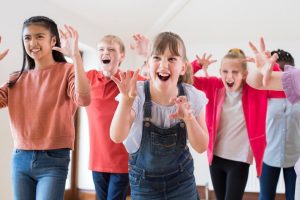
Characteristics of the performing arts can be essential to the well-being of children. Although not mentioned or heavily encouraged by parents, the arts are a key factor in improving the life of children. They are alive but should also be living a fulfilling life regardless of age. Combining imagination, play, and performing arts can lead to many benefits in children.

A prime example of performing arts is role play. All children engage in play, whether solo or group play. Imaginative play can lead to a more artistic play, meaning that there is a possible connection between imagination and the performing arts.  

There are four functions that the arts can provide children with: activity, belonging, identity and ownership, all important in contributing to the needs of their development as well as their quality of life. Overall, there is more meaning to when parents tell their children to “go and play,” it also means to outwardly express themselves and expand their knowledge that there is a figurative world to engage in.  

To read more, click here! 

Ashley Bejar, UConn KIDS Research Assistant 

Trivia Tuesday

October 22, 2024

Welcome back to Trivia Tuesday!

This weeks question is…True or false: A mesosystem, according to the American Psychological Association (2018), is defined as “the groups and institutions outside the home (ex. day care, school, a child’s peer group) that influence the child’s development and interact with aspects of the microsystem (ex. relations in the home)”

A. True
B. False 

Last weeks question was “What is an example of multifinality: ‘any one component may function differently depending on the organization of the system in which it operates.'” The answer was A, “the same childhood experience can lead to different outcomes in adulthood”!

Tune in next week to find out the answer to this weeks question!

The Effects of Pets at Home on Children’s Empathetic Tendencies

October 21, 2024

Most young children want a pet at some point in time, however what are the effects of taking on a new member of the family? 

Children learn through experiences, and having a pet at home can help increase responsibility and empathetic skills. 

A study was conducted to find the connection between empathetic tendencies and having a pet at home. A Personal Information Form was filled out to find out information about the children and their families and an Empathetic Tendency Scale was used to determine the empathetic tendencies within the children. The overall results found that having a pet at home was associated with a significant difference in the mean scores of empathetic tendencies. The results were interpreted as children are given responsibilities when having a pet, which is important factor contributing to empathy. 

If you have a child at home, it might be a good idea to consider taking on a furry friend as another member of your family!

If you want to read more, click here!

Kaitlyn Vitucci
UConn KIDS, Research Assistant

What it’s like to be a child of immigrants

October 17, 2024

Children of immigrants grow up with ties to their country of origin as well as the country they grow up in. They’re raised with a mix of foods, music, beliefs, expectations, language, etc., from two (or more) different cultures. Not just in the United States, but around the world, many individuals balance their identify on such classifications. 

What separates us from our parents is that our parents were born in their country of origin whereas we were born in a different one. Therefore, the parents are viewed as first generation immigrants and their children as second-generation immigrants. 

Children who grow up in such families face many misconceptions, judgments, and overall challenges about their cultural identity. In their home country, they’re seen as a citizen of the country they grew up in, and in the country, they grew up in, they’re seen as citizens of their home country. But it’s important to consider that they can be both, and that we are all a “salad bowl.” 

To watch the full Ted Talk, click here! 

Ashley Bejar, UConn KIDS Research Assistant 

The Power of Bedtime Routines

October 16, 2024

A typical bedtime routine for a child may look like brushing their teeth, putting on pajamas and then going to bed. What researchers found was that incorporating a language-based activity into a child’s bedtime routine can significantly improve their sleep and cognitive growth. This can take the form of reading, storytelling, or even singing.  

The study that this article focuses on revealed that children who regularly experienced these language-based activities slept longer and scored higher on verbal tests by the age of 5. It was also shown to have links to lower levels of anxiety and aggression. Something as simple as reading a bedtime story at bed proved to have a profound impact on children’s development. 

Interested in reading more? Click here! 


Rachel Silverman 

UConn KIDS, Research Assistant 

Trivia Tuesday

October 15, 2024

Welcome back to Trivia Tuesday!

This weeks question is…What is an example of multifinality: “any one component may function differently depending on the organization of the system in which it operates.”

A. The same childhood experience can lead to different outcomes in adulthood
B. People with different experiences in childhood can develop the same mental health disorder

Last weeks question was “True or false: a “rooting reflex” is defined as “an automatic, unlearned response in newborns to a gentle stimulus on the cheek or corner of the mouth.” A newborn will turn their heads and make a sucking motion.” The answer was true!

Tune in next week to find out the answer to this weeks question!

Do babies learn from baby media?

October 14, 2024

Baby media has been around for decades. Most notably, the rise of the “Baby Einstein” TV series since 1997 has captivated parents, believing that such media would make their babies learn better and faster. From old VHS tapes to current media, parents have been quoted and testified to the benefits of media on infant development, thus encouraging more parents to do the same for their children. 

However, parents who say that exposure to media assisted in their child’s development could in fact be mistaken. A phenomenon occurs in the second stage of an infant’s stage of life, called the “word spurt” where they gain knowledge of many new words. This phenomenon could instead be aiding in development rather than media exposure.  

Researchers wondered how many new words 12–18-month-old infants can learn from watching a popular series multiple times a week. Interestingly, the results yielded that children who viewed media more often did not learn new words compared to children who didn’t watch any media. Therefore, they concluded that infant media was not as useful to development as parents think; rather, parents overestimate the influence of media on their children. 

To read more, click here! 

Ashley Bejar, UConn KIDS Research Assistant

Significance of Friendships through a Neuroscience Perspective

October 11, 2024

There is no doubt that teens value their friends and what they think of them. In fact, friendship is considerably one of the most important parts of adolescence. High quality friendships have been related to positive developmental outcomes, as well as mental health. Conversely, quality friendships can help to protect against the negative effects of hardships. But what about the way these friendships actually affect the brain itself?

Interestingly, there seems to be a connection between reward and friendships. There were a few areas of activation when a brain imaging study was done, having teens visualize their friends and having them determine whether they would approach them. However, two of note were the ventral striatum(VS) and the ventromedial prefrontal cortex (vmPFC). The VS has been well established on its role in reward in the brain, but the role of the VS and vmPFC has been hypothesized to form a valuation system in the brain. This means that they guide decision making by responding to rewards. These areas can be more activated during the sharing of emotions, such as watching an emotional video together. 

If you want to read more about how friendships affect the brain, click here!

Kaitlyn Vitucci
UConn KIDS, Research Assistant

What do babies think?

October 10, 2024

If I were to ask you what babies think, your response would most likely be nothing. We think of babies as having blank minds and slowly absorbing the world around them. According to research, babies are far more ahead than we first imagine. In her Ted Talk, Gopnik talks about different studies that showcase babies’ abilities to learn. She even goes as far as that babies are designed to learn due to their powerful brains.  

She draws a comparison between babies and scientists in the sense that they both observe, hypothesize, experiment, and draw conclusions. While they do not do this to the same degree, the idea is still there!

Interested in learning more? Click this link here to watch! 


Rachel Silverman 

UConn KIDS, Research Assistant 

Anxiety probability in children and dogs

October 9, 2024

Boy playing with puppy on steps outdoors

Pets, to many, are an extension of our families. We view our lovely 4-legged friends as one of our own. They bring us tons of laughs, love, and other positive benefits!

One of those benefits includes reducing anxiety in kids. This study has found that dogs have led to a probable decrease in anxiety levels in children. Because this study demonstrates the probability of this relationship to exist, it opens the door for future studies to examine how and why this may be in the case. In the meantime, it is another reason to love our furry friends even more!

To read more about this study, click here!

Mikayla Clemens

Research Assistant, UConn KIDS